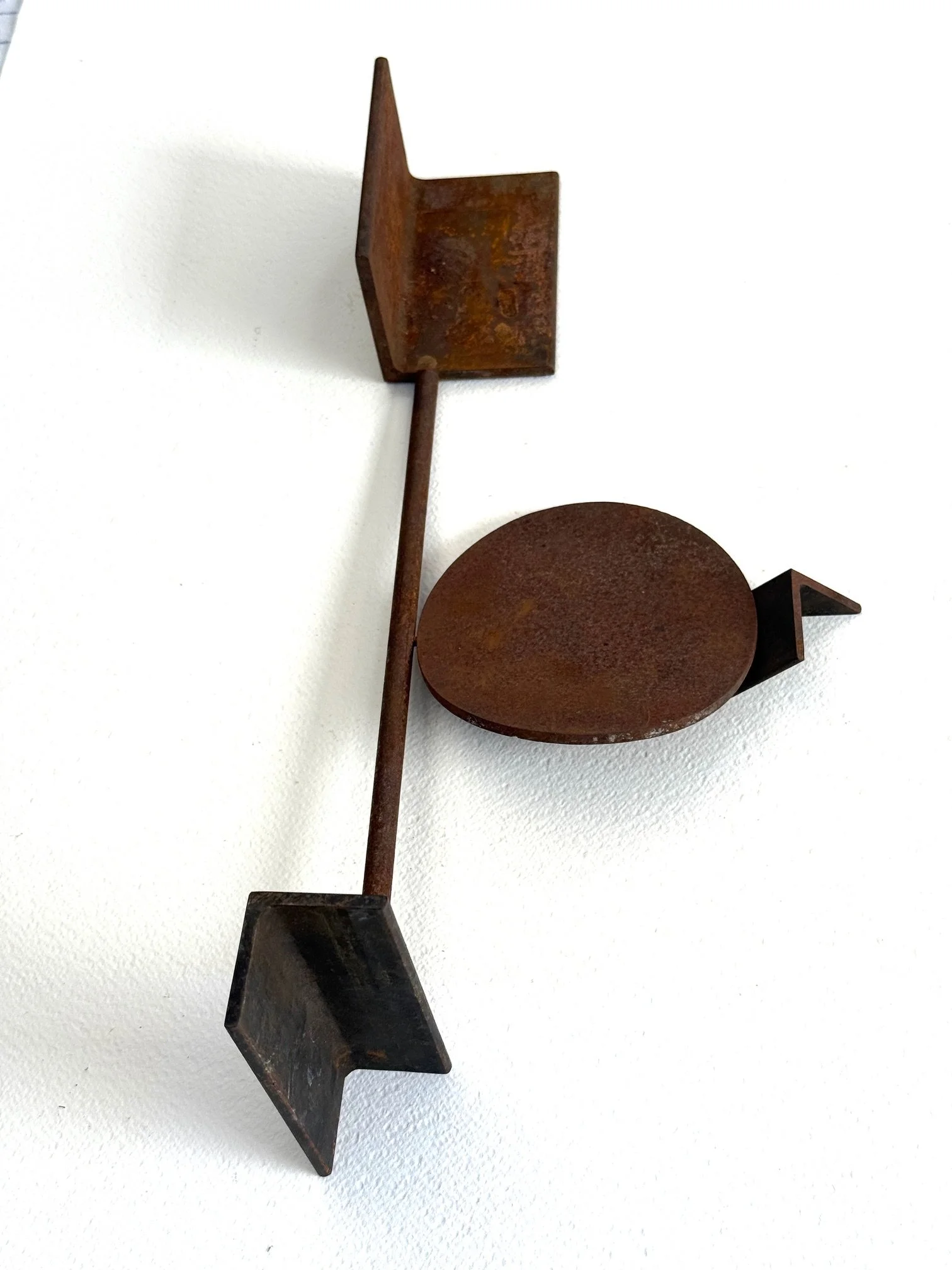
Writer and commentator Jeremy Eccles quite rightly asked me at the opening of the 5 Easy Pieces exhibition at Defiance Gallery, why ‘English Sculpture?’
My contribution to the exhibition had that title.
I offered a glib answer to his question, which I am here seeking to answer more seriously.
For those observant or interested, the title was in fact provocative. What was I getting at, with such a title?
The premise of the exhibition was that the same modest supply of raw material presented the sculptor with endless possibilities to express themselves and their ideas.
My ‘English Sculpture’ argues that the brief is a trap and the best you can do to realise the opportunities is to allow the 5 pieces to just be themselves. Best to keep them mute. Avoid the promised life of play.
The prospect of ‘play’ was unarguable, surely? Who could reasonably argue against such a generous offer?
On beginning to work, I found that as soon as I started to shape the material, the space in which the material sat, shrank. The more the material was worked the shrinkage continued. The object may have been enhanced from having been worked, but the marriage of space and material broke down. Much as we want to emulate the modelling properties of more compliant materials, the use of steel is always best as the agent for dividing up spaces.
Ultimately I found that doing as little as possible did the most to keep the space in which the material sat, active and alive and full of air.
Whatever else we would like sculpture to be it can be ultimately nothing greater than the occupation and clarification of a space. It needs to be a field.
A short history of mid 20c sculpture:
English sculptors successfully applied ‘The Field’ discoveries in American art to sculpture in the 1970’s.
American sculpture after David Smith had failed to implement what Pollock, Newman, Rothko, Lewis had achieved in painting. Caro and his school did much better than Tony Smith, Carl Andre and Di Suvero to apply those innovations.
American art was all about the field. Subject, subjectivity, the author, all was redundant to a bigger world of ‘The Field’.
I don’t mind a brief. Sometimes we grow better, restrained.
As a movement of sculpture, we are doing what we can to keep a sculptural language refreshed and alive. If a brief induces us to make an English sculpture to bring the best outcome, then we need another brief. Having said that, it is shows such as this that provoke conversation, to find what we share and what we keep to ourselves. If we are a dying breed then bring on the end, to clarify the mind!
Note: My ‘English Sculpture’ is the same sculpture I presented in the earlier 2010 iteration of the idea. It shows that while I may wander in my practice I am consistent with my ideas!
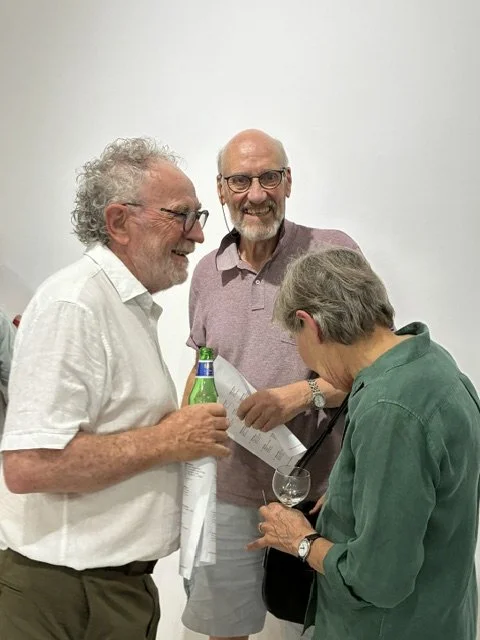
Jeremy Eccles, Jan King and me at the opening of ‘Five Easy Pieces’.
Photo courtesy Michael Buzacott